

Soccer Cleat Size Guide Kids vs Adults: How to Get the Perfect Fit Every Time
Last Updated on: 15th May 2026, 09:18 pm
Getting the right soccer cleat size is one of the most important decisions you make as a player or as a parent buying for one. The wrong size does not just cause discomfort. It affects how a player moves, how they strike the ball, and over time, it can lead to blisters, black toenails, and even injury.
Soccer cleats should fit snugly with about a thumb’s width of space between the longest toe and the front of the cleat. But kids and adults size very differently, sizing systems vary across brands and countries, and there are specific rules for growing feet that change everything.
This guide covers everything how to measure your foot correctly, how kids’ sizing works, how adult sizing differs, conversion charts across US, UK, and EU systems, brand-by-brand fit notes, and exactly when to size up or down.
Why Soccer Cleat Sizing Is Different From Regular Shoe Sizing
The first thing to understand is that soccer cleats are not sized or built like sneakers. They are designed to give the foot maximum contact with the ball, which means they fit closer and more precisely than casual footwear.
Most soccer players, both adults and youth wear their cleats either true to size or a half size up compared to their regular shoes. A cleat that fits like a comfortable sneaker is actually too loose for the pitch. You want a snug fit without pressure points, especially across the toe box and the instep.
This matters even more for kids, whose feet are still developing. A cleat that is too tight restricts natural foot growth. One that is too loose causes sliding inside the boot, which creates friction, blisters, and can affect a young player’s confidence and coordination on the ball.
How to Measure Your Foot the Right Way
Before you look at any size chart, measure your foot. Brand size charts mean very little if you do not know your actual foot length in centimetres or inches.
Step-by-step foot measurement:
- Tape a piece of paper to a hard, flat floor, not carpet.
- Stand on the paper with your weight evenly distributed. Do not sit or lean forward.
- Using a pencil held straight down, mark the tip of your longest toe and the back of your heel.
- Step off the paper and measure between the two marks with a ruler.
- Measure both feet. Most people have one foot slightly larger than the other. Always use the measurement of the larger foot.
- Measure in the afternoon or evening, feet naturally swell slightly throughout the day and are largest later on.
- Wear the socks you will actually play in when measuring. Thick sports socks versus thin ankle socks can shift the fit by half a size.
Once you have your measurement in centimetres, use the size charts below to find your correct size across the US, UK, and EU systems.
Kids Soccer Cleat Size Explained
Kids’ soccer cleat sizing is the area that causes the most confusion, especially for parents buying cleats for the first time. The reason is that children’s footwear in the United States uses three separate sizing ranges that apply at different ages, with numbering resetting between them.
The three children’s sizing ranges:
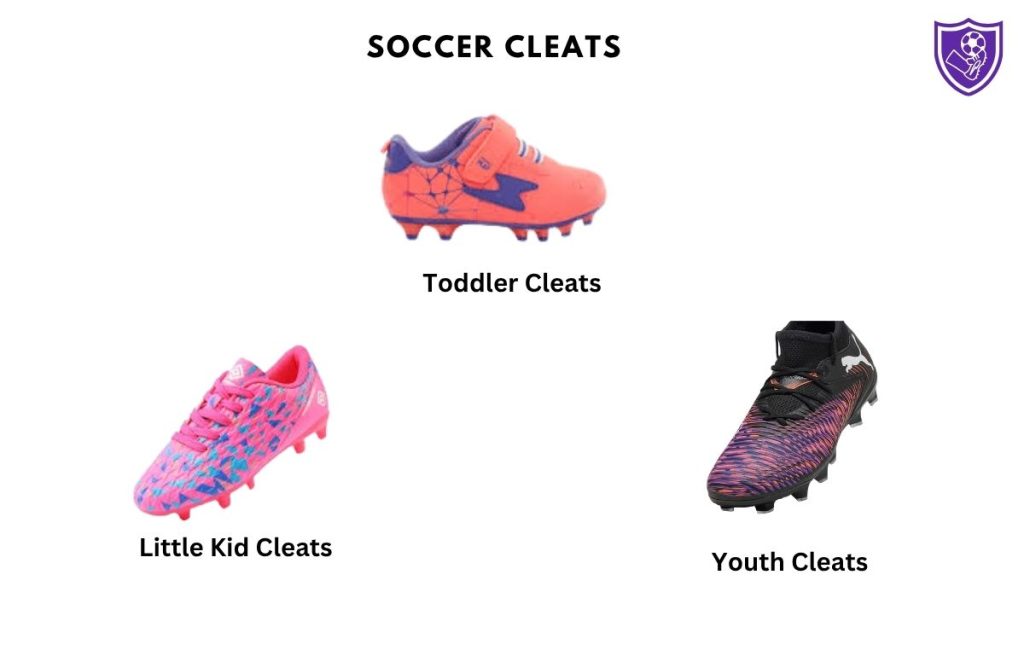
Toddler (T or C): Ages 2 to 4, approximately sizes 3C to 9C. Toddler cleats are the smallest, designed for children just starting to play organised football. The “C” stands for “child” and sizes run from roughly 3C up to 10C. These cleats prioritise flexibility over performance. Young feet are still forming and need freedom of movement. Look for Velcro closures rather than laces at this age, as they are easier for young children to manage and more secure.
Little Kid (K): Ages 4 to 7, approximately sizes 10.5C to 3K. As children outgrow toddler sizes, they move into the Little Kid range. The letter system continues, but the K designation indicates a slightly more structured shoe. Cleats at this stage introduce more traditional features, such as some laces and slightly firmer outsoles, while still offering cushioning for developing feet.
Youth (Y): Ages 7 to 12, approximately sizes 1Y to 7Y. When the Little Kid range reaches 13K, the numbering resets to 1Y. This is the Youth range, and it covers the most active growth phase for most junior players. A US size 1Y is roughly equivalent to a UK size 13 and a EU size 32. Youth sizes run up to 7Y, at which point most players transition into adult sizes.
Kids’ Cleat Size Chart (US, UK, EU)
| Age Range | US Size | UK Size | EU Size | Foot Length (cm) |
| 2–3 years | 8C | 7 | 24 | 14.6 cm |
| 2–3 years | 9C | 8 | 26 | 15.2 cm |
| 3–4 years | 10C | 9 | 27 | 16.5 cm |
| 4–5 years | 11C | 10 | 28 | 17.1 cm |
| 4–5 years | 12C | 11 | 30 | 17.8 cm |
| 5–6 years | 13C | 12 | 31 | 18.4 cm |
| 6–7 years | 1Y | 13 | 32 | 19.1 cm |
| 7–8 years | 2Y | 1 | 33 | 19.7 cm |
| 8–9 years | 3Y | 2 | 35 | 20.6 cm |
| 9–10 years | 4Y | 3 | 36 | 21.6 cm |
| 10–11 years | 5Y | 4 | 37 | 22.5 cm |
| 11–12 years | 6Y | 5 | 38 | 23.5 cm |
| 12–13 years | 7Y | 6 | 40 | 24.4 cm |
Important note: These age ranges are approximations only. Children’s feet develop at very different rates. Always base your size selection on the actual foot measurement, not the age range shown.
Should You Buy Kids Cleats a Size Bigger to Allow for Growth?
This is one of the most common questions parents ask, and the answer requires nuance.
For younger children aged 4 to 7 who grow quickly, going half a size up from the measured size is generally fine, as it extends the life of the cleat by a few months and still allows for a functional fit. Going a full size up is not recommended, as a cleat that is too long causes the foot to slide forward during running and shooting, which affects control and increases the risk of blisters on the toes.
For youth players aged 8 and above who are in more regular training and competitive matches, fit precision matters more. At this stage, buy the correct measured size and replace the cleats when needed. A poorly fitting cleat for a competitive youth player is a bigger problem than replacing cleats every season.
As a rule of thumb, leave approximately one thumb’s width (around 1 to 1.5 cm) between the tip of the longest toe and the end of the cleat. Any more than that and the cleat is too big. Any less and it will be too tight once game intensity increases.
Adult Soccer Cleat Size Explained
Adult cleat sizing is more straightforward than kids’ sizing, but still varies meaningfully across brands. Most adult men’s cleats run from US size 5.5 to US size 15, with women’s cleats typically starting at US size 5 and running to US size 11 or 12.
The key principle for adults is the same as for kids: cleats should fit closer than regular shoes. Most adult players either wear their exact size or go a half size up from their regular sneaker size.
Adult Cleat Size Chart (Men’s US, UK, EU)
| US Size | UK Size | EU Size | Foot Length (cm) |
| 5.5 | 5 | 38 | 23.5 cm |
| 6 | 5.5 | 38.5 | 24.1 cm |
| 6.5 | 6 | 39 | 24.4 cm |
| 7 | 6 | 40 | 25.1 cm |
| 7.5 | 6.5 | 40.5 | 25.4 cm |
| 8 | 7 | 41 | 25.7 cm |
| 8.5 | 7.5 | 42 | 26.0 cm |
| 9 | 8 | 42.5 | 26.7 cm |
| 9.5 | 8.5 | 43 | 27.0 cm |
| 10 | 9 | 44 | 27.6 cm |
| 10.5 | 9.5 | 44.5 | 28.3 cm |
| 11 | 10 | 45 | 28.6 cm |
| 11.5 | 10.5 | 45.5 | 29.2 cm |
| 12 | 11 | 46 | 29.8 cm |
| 13 | 12 | 48.5 | 31.1 cm |
Adult Cleat Size Chart (Women’s US, UK, EU)
| US Size | UK Size | EU Size | Foot Length (cm) |
| 5 | 3 | 35.5 | 22.2 cm |
| 5.5 | 3.5 | 36 | 22.5 cm |
| 6 | 4 | 37 | 23.1 cm |
| 6.5 | 4.5 | 37.5 | 23.5 cm |
| 7 | 5 | 38 | 24.1 cm |
| 7.5 | 5.5 | 38.5 | 24.4 cm |
| 8 | 6 | 39 | 25.1 cm |
| 8.5 | 6.5 | 40 | 25.7 cm |
| 9 | 7 | 40.5 | 26.0 cm |
| 9.5 | 7.5 | 41 | 26.7 cm |
| 10 | 8 | 42 | 27.3 cm |
| 11 | 9 | 43 | 28.3 cm |
Brand-by-Brand Sizing Notes
Every major cleat brand fits slightly differently. Knowing the quirks of each brand before you buy saves you from ordering the wrong size online.
Nike Cleats: differentiates between two fit profiles. Their “natural fit” models (Tiempo, Phantom) suit wider feet and generally run true to size. Their “contoured fit” models (Mercurial) run slightly narrow and are designed for players who want a close, barefoot feel. If you have a wider foot and are buying Mercurials, go half a size up from your normal Nike size. Youth Nike cleats generally run true to size.
Adidas Cleats: typically run true to size across most models. The Copa range, being leather-based, tends to stretch slightly after a few sessions, so if you are between sizes, go with the smaller one. The Predator and F50 ranges fit slightly more snugly than the Copa line. Adidas youth cleats run true to size, with sizes generally ranging from around 5K to 7Y.
Puma cleats have historically run slightly narrow and slightly long. Many players go half a size down from their regular shoe size in Puma models, though this has improved in recent years. Try before buying where possible, or check the specific model’s fit notes when buying online.
New Balance: is one of the better brands for players with wider feet. Their cleats run true to size with a more generous toe box than Nike Mercurials or Pumas speed boots. The 442 range is particularly recommended for players who struggle with narrow-fitting cleats.
Mizuno Cleats: particularly the Morelia range, are cut slightly narrow and long. Japanese footwear brands tend to fit differently from European and American ones. Players with wider feet should try before buying or consult specific model fit reviews.
Kids vs Adults: The Five Key Differences in How Cleats Are Built
Beyond sizing, it is worth understanding that kids’ cleats and adult cleats are built differently by design, not just scaled versions of each other.
Sole flexibility:
Kids’ cleats, especially at the toddler and little kid stages, have more flexible soles than adult models. Young feet are still developing, and a rigid outsole can restrict natural foot movement and growth. Adult cleats prioritise performance and stability over flexibility.
Stud design:
Most kids’ cleats use moulded rubber or plastic studs rather than the detachable metal studs found on some adult models. This is both safer for young players in physical contact situations and more appropriate for the softer, lighter strikes of younger footballers.
Upper material:
Adult performance cleats often use thin synthetic materials or specialised knit uppers designed for maximum ball feel and minimal weight. Kids’ cleats use thicker, more padded uppers that cushion growing feet and handle the general rough-and-tumble of youth football.
Closure systems:
Toddler and little kid cleats frequently offer Velcro or elasticated closures because younger players cannot tie laces reliably. Youth and adult cleats use traditional laces, sometimes with hidden or asymmetric lacing systems for increased ball contact.
Price and durability:
Adult performance cleats are priced for longevity. A player whose feet have stopped growing can expect several seasons from a quality pair. Kids’ cleats are priced lower and built for a shorter lifespan, because growing feet will outgrow the cleats before it wears out. There is no value in buying premium performance cleats for a child under 10 whose feet will change significantly within months.
Signs Your Soccer Cleats Do Not Fit Correctly
Whether you are shopping for yourself or your child, these are the warning signs that a cleat is the wrong size:
Too small: Toes pressing against the front of the boot. Black or bruised toenails after matches. Blisters on the tips of toes. Cramping in the foot or toes during play.
Too big: The heel lifts inside the cleat when running. Visible space between the toe and the front of the boot when standing. Blisters on the back of the heel from rubbing. Sliding inside the boot when changing direction.
Wrong width: Pinching along the side of the foot. Numbness or tingling during play. The upper bulges out over the sole. Discomfort across the ball of the foot.
When to Replace Soccer Cleats
For adults: Replace cleats when the studs are visibly worn down (which affects traction), when the upper develops cracks or tears, or when the sole begins to separate from the upper. A well-maintained adult cleat from a quality brand typically lasts one to two seasons of regular play.
For kids: Replace based on fit, not condition. Young children can outgrow cleats in as little as two to three months. Check fit at the start of every new season and recheck mid-season for children under eight. If you can feel the toes pressing against the front, it is time for a new pair, regardless of how new the cleats look.
FAQs:
Do soccer cleats run small?
Not consistently. Nike Mercurials run slightly small due to their contoured fit. Adidas Copa, being leather, stretches slightly and can feel small initially before moulding to the foot. Most other mainstream models run true to size. Always measure your foot and check the brand-specific notes above rather than assuming.
Can my child wear adult cleats?
Once a child’s foot reaches a US size 6 or 6.5, they can begin wearing adult cleats. Youth sizes typically end at 7Y, which is equivalent to a US adult men’s 7. However, note that adult cleats are built with less flexibility and padding than youth models. A transition at 6Y or 7Y is fine, but not before.
How much room should be in soccer cleats?
One thumb’s width, approximately 1 to 1.5 cm, between the tip of the longest toe and the front of the cleat. This applies to both adults and kids.
Should I size up for wide feet?
Going up a half size can help if you have wide feet and the specific model runs narrow. However, the better solution is to choose a model designed for wider feet: New Balance 442, Nike Tiempo, or Adidas Copa. Sizing up can create too much length even when it resolves the width issue.
Final Thoughts:
Getting the right size soccer cleat is the foundation of everything: comfort, performance, and long-term foot health. For adults, the process is straightforward: measure your foot, use the brand size chart, and factor in the specific model’s fit profile.
For kids, take the time to understand the toddler, little kid, and youth size systems, always measure both feet, and prioritise fit over leaving excessive growth room.
No size chart replaces trying cleats on in person, where possible. But when you are buying online, following the measurement method in this guide and cross-referencing with the tables above will get you as close to the right fit as possible without walking into a store.
A well-fitting cleat is one that the player barely notices. That is exactly the point.

My name is Muhammad Abdullah. I picked up a football at age 11 and never really put it down. At 16, I joined Prince Football Club in Duniyapur, where I still play today as a right forward. I started Footricks to share what I actually learned from years on the pitch not what looks good on a spec sheet. Whether you’re just starting out or leveling up this is for you.


