

The First Soccer World Cup, Uruguay 1930
Last Updated on: 3rd June 2026, 09:37 am
Most people know soccer as the world’s most popular sport, but very few stop to think about where it all started, at least in terms of international competition. The story of the first World Cup is one of ambition, sacrifice, and a small South American nation that dared to dream bigger than anyone expected. If you have ever searched for when the first soccer World Cup was, the answer takes you straight to Uruguay, 1930.
When Was the First World Cup Held?
The first World Cup was held in July 1930, running from July 13 to July 30. It was organized by FIFA under the leadership of Jules Rimet, a French football administrator who had been pushing for a global championship for years. Uruguay was chosen as the host nation, and for good reason; they were the reigning Olympic football champions, having won gold in both 1924 and 1928.
The decision to hold the first FIFA World Cup in South America was not without controversy. European nations were reluctant to travel such a long distance, and the global economy was already suffering under the early weight of the Great Depression. Despite all of this, thirteen nations made the journey and took part in the tournament.
The First World Cup Teams and Format
The first World Cup did not look anything like the modern tournament. There were no qualifying rounds, no group stage drama broadcast on television, and no global fanfare. FIFA simply extended invitations and hoped teams would accept.
Only four European nations made the trip: France, Belgium, Romania, and Yugoslavia. The rest of the thirteen teams came from South America and North America. The format used a group stage feeding into semi-finals and a final, all played in Montevideo, Uruguay.
The Estadio Centenario was built specifically for the tournament. Workers raced to complete it in time, and it was finally ready for the semi-finals, hosting a crowd of around 93,000 for the final match.
The United States and Its Surprising Position
One of the biggest talking points of the World Cup 1930 was the United States. Their position in the tournament genuinely surprised people. The American squad, made up largely of players with British backgrounds, topped their group after beating Belgium 3–0 and Paraguay 3–0. They marched into the semi-finals, where they ran into a very strong Argentina side and lost 6–1.
For a nation not traditionally associated with football at that time, reaching the last four of the very first World Cup remains one of the most underrated achievements in American sporting history.
Which Country Won the First Soccer World Cup?
The answer to which country won the first soccer World Cup is Uruguay. But the way they won it made the victory even more special.
The final was played on July 30, 1930, between Uruguay and Argentina, two fierce rivals separated only by the River Plate. Argentina took the lead and went into half-time winning 2–1. The home crowd inside the Estadio Centenario fell quiet. It looked like Uruguay might lose its own tournament.
But the second half told a completely different story. Uruguay came back with goals from Pedro Cea, Santos Iriarte, and Héctor Castro to win 4–2. The comeback was complete. Uruguay were crowned the first-ever World Cup champions on home soil.
The country declared a national holiday. Across the river in Buenos Aires, the Uruguayan consulate was attacked by upset Argentine fans. The rivalry between these two nations had just reached a completely new level.
Key Players of the First FIFA World Cup
No article about the first FIFA World Cup would be complete without mentioning the players who made it memorable.
Guillermo Stábile of Argentina finished as the top scorer with eight goals in just four matches. This record stood as a statement of his class even in a tournament Argentina ultimately lost. He became the first-ever Golden Boot winner in World Cup history.
For Uruguay, captain José Nasazzi was the rock at the back, commanding his defence with authority. Héctor Scarone was the creative force going forward, constantly causing problems for opposition defenders who simply could not keep up with his movement.
Jules Rimet, watching from the stands, presented the trophy, which was later renamed in his honour, and witnessed his life’s work become a reality.
Why the World Cup 1930 Still Matters
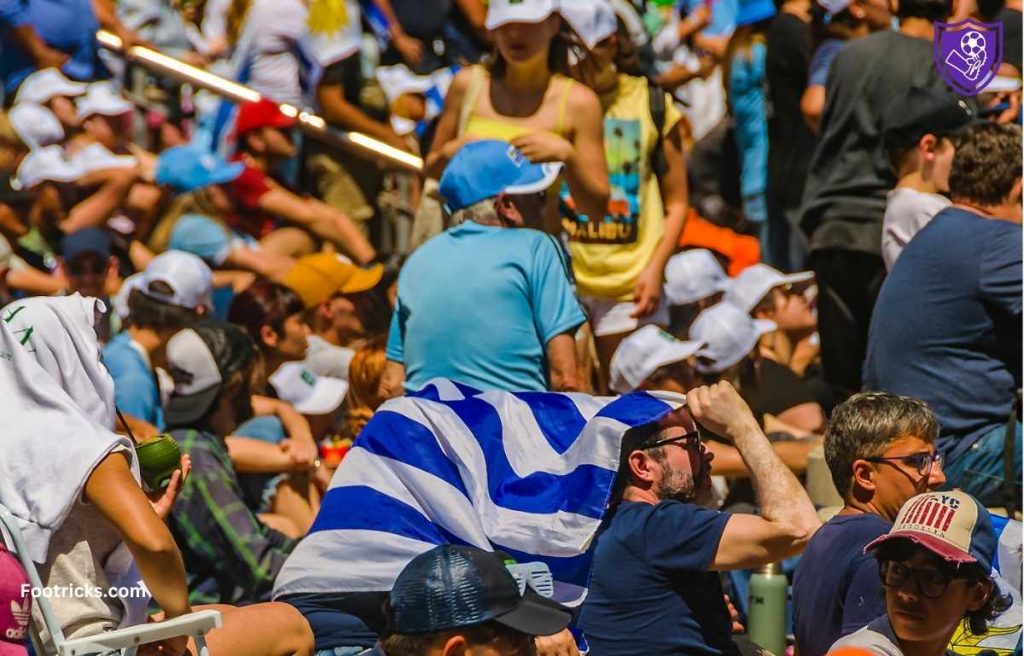
The World Cup 1930 was small by today’s standards. Thirteen teams, eighteen matches, no television coverage, and no internet to follow the scores. But what it started cannot be measured in numbers.
It proved that football could bring nations together across oceans and continents. It showed that South America was not playing catch-up with European football; it was leading it. And it gave the sport a permanent global stage that has only grown bigger and brighter with every passing tournament.
Uruguay’s victory in 1930 remains one of the most iconic moments in football history, not because of the goals or the scoreline, but because it happened at all. The first World Cup was proof that football truly belonged to the entire world.
1930 vs 2026: How Far Has the World Cup Come?
The difference between the 1930 World Cup and the 2026 FIFA World Cup is almost impossible to put into words. In 1930, thirteen teams showed up after weeks at sea, played in a half-finished stadium, and the whole tournament lasted just eighteen matches. In 2026, the World Cup expands to 48 teams spread across three host nations, the United States, Canada, and Mexico, with 104 matches scheduled across brand new and iconic stadiums.
Back in 1930, there was no television, no live commentary, and no global audience. In 2026, billions of people will watch every kick on their phones, tablets, and screens from every corner of the world. The prize money has gone from a small trophy to hundreds of millions of dollars. Yet at the heart of it, the game remains the same: eleven players, one ball, one goal. Uruguay 1930 planted the seed. The 2026 World Cup is the tallest tree it has ever grown into.
Final Thoughts
If you ever wondered when the first World Cup was, which country won the first soccer World Cup, or what the first FIFA World Cup actually looked like, now you know the full story. It was raw, uncertain, and built on compromise. But it was also glorious, historic, and absolutely worth every mile of that Atlantic crossing.
Uruguay 1930 did not just start a tournament. It started a tradition that billions of people now share.

My name is Muhammad Abdullah. I picked up a football at age 11 and never really put it down. At 16, I joined Prince Football Club in Duniyapur, where I still play today as a right forward. I started Footricks to share what I actually learned from years on the pitch not what looks good on a spec sheet. Whether you’re just starting out or leveling up this is for you.


