1930 vs 2026 FIFA World Cup: How Everything Changed in 96 Years
Last Updated on: 3rd June 2026, 10:06 am
Football has always been more than just a game. It is a living, breathing institution that grows, adapts, and reinvents itself with every passing generation. Nothing proves that better than comparing the very first FIFA World Cup held in Uruguay in 1930 with the upcoming 2026 FIFA World Cup set to be hosted across the United States, Canada, and Mexico.
The differences are staggering, from the number of teams to the rules, the format, the money, the technology, and the global reach. What started as a modest thirteen-team tournament in a half-built stadium has evolved into the single biggest sporting event on the planet. This is the full story of how everything changed.
Teams From 13 to 48
Perhaps the most obvious difference between the two tournaments is the number of teams involved.
In 1930, FIFA invited nations to participate and hoped they would say yes. Only thirteen teams accepted. Four came from Europe: France, Belgium, Romania, and Yugoslavia, after much persuasion from FIFA president Jules Rimet. The rest came from South America and North America. There were no qualifying rounds, no playoffs, no continental competitions to earn a spot. You received an invitation, and you either came or you did not.
The 2026 FIFA World Cup tells a completely different story. For the first time in history, the tournament expands from 32 teams to 48 teams. Every major footballing region on the planet now has a greater slice of representation. UEFA gets 16 spots, CONMEBOL gets 6, CAF gets 9, AFC gets 8, CONCACAF gets 6, and OFC gets 1, with one playoff spot available. Nations that have never appeared at a World Cup before will finally get their chance. The qualification process alone now spans nearly three years and involves almost every FIFA member nation, over 200 countries fighting for 48 places.
From 13 invitees to 48 qualified nations. The growth alone tells you everything about how football has spread across the world.
Format Groups, Knockouts, and New Rounds
In 1930, the tournament format was straightforward. The thirteen teams were split into four groups. The top team from each group advanced to the semi-finals. Two semi-finals, a third-place match, and a final. Eighteen matches in total across the entire tournament.
The 2026 World Cup format is significantly more complex. The 48 teams are divided into 12 groups of four teams each. The top two from every group advance automatically, and the eight best third-placed teams also go through, giving 32 teams a place in the round of 32. From there, it follows the traditional knockout structure: round of 32, round of 16, quarter-finals, semi-finals, third-place play-off, and the final.
The total number of matches jumps from 18 in 1930 to 104 in 2026. That is nearly six times more football, spread across an entirely new round of competition that did not exist before.
Host Nations: One Country vs Three
Uruguay hosted the entire 1930 World Cup alone. Every single match was played in Montevideo. There were only three stadiums used: Estadio Centenario, Estadio Gran Parque Central, and Estadio Pocitos. The Centenario was still under construction when the tournament began and was only ready in time for the later stages.
The 2026 World Cup breaks new ground by using three host nations simultaneously: the United States, Canada, and Mexico. This makes it the first World Cup ever to be hosted across three countries. Sixteen cities are involved, with stadiums spread from Vancouver in Canada to Guadalajara in Mexico to New York, Los Angeles, Dallas, and Miami in the United States. The sheer geographical scale would have been unthinkable to anyone watching the 1930 final in Montevideo.
Rules and Regulations: What Changed on the Pitch
Football in 1930 was recognisable but noticeably different from the modern game. Several rules that players and fans now take for granted simply did not exist.
There were no substitutes allowed in 1930. If a player was injured, the team played on with ten men or the injured player limped through the rest of the match. The concept of tactical substitutions did not exist at all.
Today, teams are allowed five substitutes per match, with a sixth permitted in extra time. Managers use substitutions as a core tactical tool, bringing on fresh legs, changing shape, or protecting a lead.
The offside rule in 1930 required two outfield players between the attacker and the goal line. The modern offside rule still follows this principle, but is now enforced using VAR Video Assistant Referee technology, which uses cameras and computerised lines to make millimetre-precise decisions. In 1930, a single linesman made the call with his eyes.
There was no VAR in 1930, obviously. No goal-line technology, no television replays, no fourth official. Referees made every decision in real time with no assistance. In 2026, VAR will review goals, penalties, red cards, and cases of mistaken identity. Goal-line technology will confirm within a fraction of a second whether the ball crossed the line.
Yellow and red cards did not exist in 1930 either. The card system was only introduced at the 1970 World Cup in Mexico. Before that, referees simply spoke to players or reported them after the match. The idea of a player being instantly sent off with a red card shown to their face was still decades away.
The ball itself was different, too. In 1930, a leather ball was used that absorbed water and became significantly heavier during rain. Modern match balls are synthetic, water-resistant, and aerodynamically designed to behave consistently in all weather conditions.
Referees and Match Officials
In 1930, each match had one referee and two linesmen. That was the entire officiating team. Decisions were final, arguments were common, and errors went uncorrected.
The 2026 World Cup will use a team of officials that includes the main referee, two assistant referees, a fourth official, two additional assistant referees behind each goal, and a full VAR team operating from a video operations room. In total, up to eight officials can be involved in a single match. The accuracy and consistency of decision-making have transformed completely.
Prize Money Nothing vs Hundreds of Millions
In 1930, there was no prize money. Teams received no financial reward for participating or winning. Uruguay lifted the trophy and went home as champions, but FIFA did not hand over a cheque. The reward was pride, prestige, and a national holiday.
By the time the 2026 World Cup concludes, FIFA is expected to distribute over $1 billion in prize money across all participating nations. The winning nation alone is expected to receive somewhere in the region of $50 million. Even teams that exit in the group stage will earn millions of dollars just for qualifying and showing up.
Football went from a gentleman’s competition with no financial stakes to one of the most lucrative sporting events in human history.
Technology and Broadcast Zero to Billions
Nobody watched the 1930 World Cup final on television because television broadcasting did not exist yet in any meaningful form. There was no live radio commentary in most countries. People outside Uruguay learned the result through newspapers, often days later. The global audience was essentially zero.
The 2026 FIFA World Cup is projected to be watched by over five billion people across television, streaming platforms, and digital devices. Every match will be broadcast live in almost every country on earth. Fans will follow along on their phones, post reactions in real time, and watch highlights within seconds of a goal being scored. Artificial intelligence will assist with broadcast graphics, player tracking, and statistical analysis. The contrast with 1930 could not be more complete.
Player Conditions and Travel
In 1930, the European teams that made the trip to Uruguay spent two weeks on a ship crossing the Atlantic Ocean. They trained on the deck. They arrived tired, unfamiliar with the climate, and with no sports science support whatsoever. There were no nutritionists, no physiotherapists, no sports psychologists, and no data analysts.
In 2026, every major national team will travel by private or chartered aircraft. Players will be supported by entire backroom teams including fitness coaches, recovery specialists, dieticians, video analysts, and mental health professionals. GPS vests will track every sprint and every heartbeat during training. Teams will have studied hours of opponent footage before a single match is played.
The professionalism of the modern game versus the amateur spirit of 1930 is another world entirely.
The Trophy
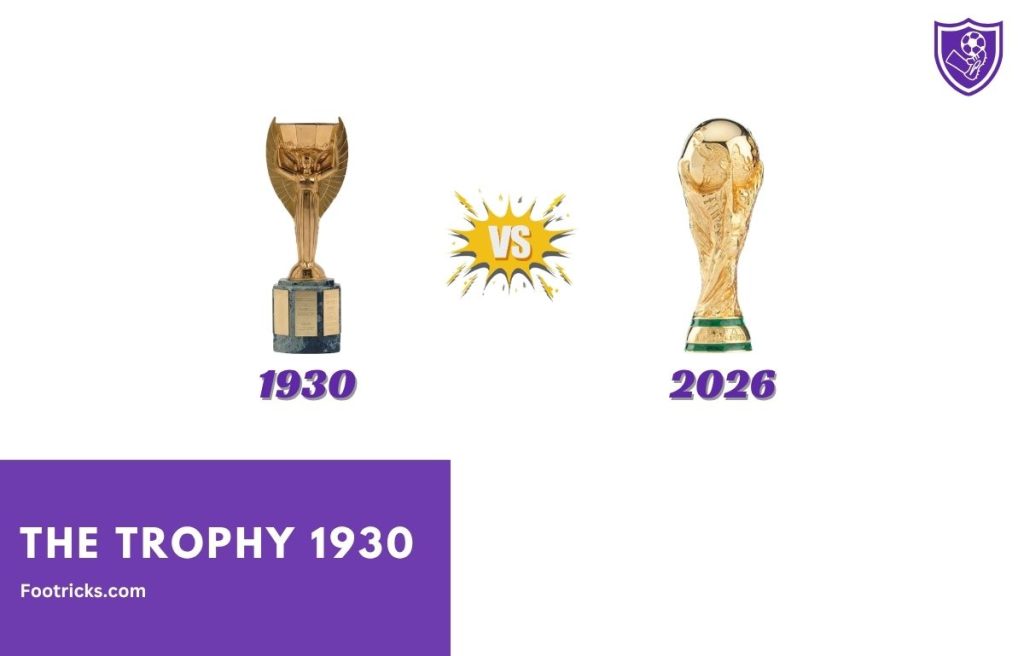
In 1930, the trophy presented was the Jules Rimet Trophy, a golden statue depicting Nike, the Greek goddess of victory. It was won outright by Brazil in 1970 after their third title and later stolen and never recovered.
Since 1974, the FIFA World Cup Trophy has been a new design, an iconic golden sculpture of two human figures holding up the Earth. It stands 36 centimetres tall, weighs 6.1 kilograms, and is made of 18-carat gold. It cannot be kept permanently by any winning nation; only a gold-plated replica is given to the champions.
Final Thoughts about 1930 vs 2026 World Cup
Everything has changed. The teams, the format, the rules, the money, the technology, the stadiums, the officials, the broadcast, the travel, and the trophy. From 13 teams in one city to 48 teams across three nations. From 18 matches to 104. From no prize money to a billion-dollar distribution. From leather balls and one referee to VAR and five substitutes.
And yet, when the whistle blows in 2026 and the ball rolls across that grass, something will feel exactly the same as it did in Montevideo on July 13, 1930. Eleven players against eleven players. One ball. One goal. The same joy, the same heartbreak, the same madness that Jules Rimet believed could unite the world.
He was right in 1930. He is still right in 2026.

My name is Muhammad Abdullah. I picked up a football at age 11 and never really put it down. At 16, I joined Prince Football Club in Duniyapur, where I still play today as a right forward. I started Footricks to share what I actually learned from years on the pitch not what looks good on a spec sheet. Whether you’re just starting out or leveling up this is for you.